
The AI Opportunity and What it Means for Virtual Sports in North America
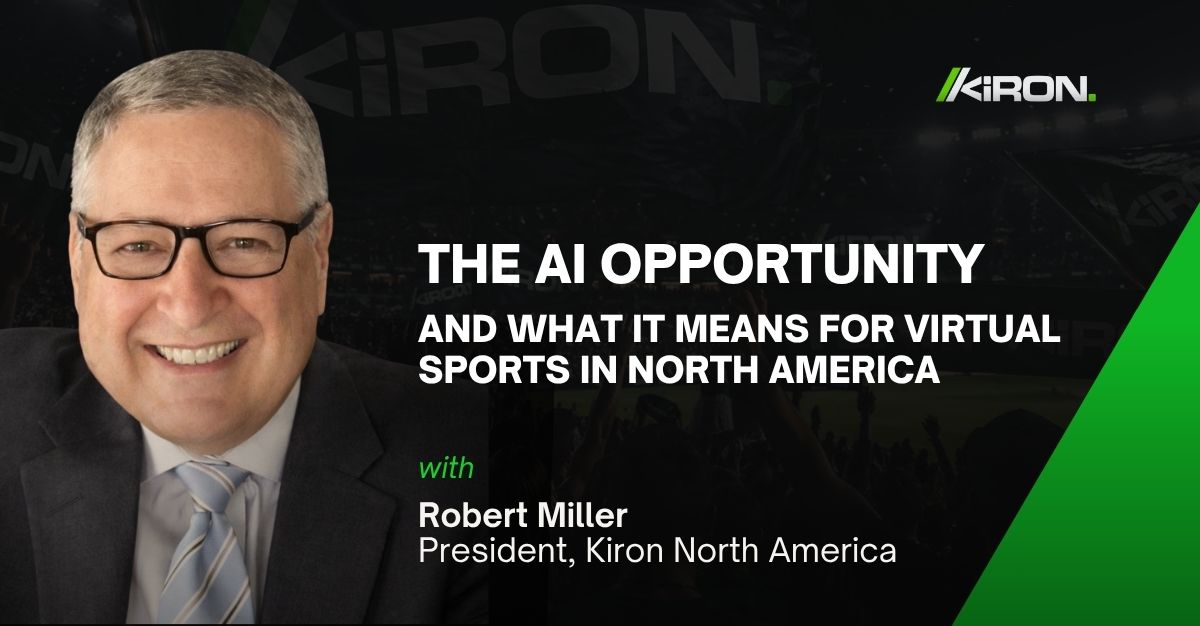
Originally published by Gaming Americas, this Q&A with Robert Miller, President at Kiron North America, explores the evolving role of AI in virtual sports and what its adoption could mean for the North American market.
From regulation and responsible gambling to player expectations and the retail experience, Robert looks at where AI can deliver practical value while maintaining a clear boundary around the certified game.
AI is the most hotly discussed topic in the industry right now. For a virtual sports supplier operating in North America, what changes can AI actually deliver in practice?
The useful question is not what AI can do. It is whether it makes the customer experience better. There is a lot of attention on efficiency, faster analysis, and producing content more quickly. Those things have value, but they are not the reason a customer chooses to spend time with a product. The more interesting opportunity is what AI can do around the experience. Virtual sports generates a considerable amount of information around each event. AI can help organize that information, add context and present it in a way that is easier to understand. It can also support richer media and presentation around the event. The customer does not need to know that AI is involved. They should simply feel that the experience is more intuitive and that the information they are receiving is relevant to what is happening. There is an important distinction here, though. AI does not create Kiron’s games or determine their outcomes. The regulated game remains separate. What we are talking about is using AI around that certified product to improve how people experience it. That distinction is fundamental, particularly in a regulated market.
How is regulation in North American markets impacting the development of AI in virtual sports and the wider iGaming industry?
This is where I think the industry needs to be very precise. A regulated gaming product has a certified core. The mathematics, wagering functionality and outcome of the game have been tested and approved. If you introduce an adaptive technology such as AI around that product, you need to be able to demonstrate that it cannot cross that boundary. You cannot simply tell a regulator that the AI does not affect the wager. You need to prove it. The system should make clear what AI can access, what it can change and, just as importantly, what it cannot touch. That is not really an AI problem. It is a strict architecture and compliance problem. In fact, building that explicit structural boundary between adaptive technologies and the certified core is exactly the kind of regulated software architecture I have been designing and putting through the provisional patent process with the USPTO this year. We are seeing the same issue emerge across other regulated industries. Many AI systems are designed to learn and adapt continuously, while regulators are accustomed to systems that are versioned, tested and approved. Those two models do not fit neatly together unless the boundaries are defined from the beginning. I think the companies that handle this well will be the ones that treat regulatory evidence as part of the product architecture, rather than something the compliance team has to create after the technology has already been built.
The responsible gambling conversation in North America is becoming more sophisticated. What role can AI play in this? And can it help make virtual sports a safer product?
AI can help us understand behavior more effectively. Operators already have a large amount of information about how customers interact with their products and better analytical tools can help identify patterns that may warrant attention earlier. But we need to separate prediction from intervention. Statistical models and AI can highlight behavioral variance, but identifying a mathematical deviation does not automatically dictate the human policy response. When should an operator intervene? What should that intervention look like? When does providing useful information become unnecessarily restricting somebody who is not experiencing harm? Those are policy and judgement questions. AI cannot answer them for us. I have looked closely at what has happened in Britain because it demonstrates how difficult this becomes in practice. The technology can give operators increasingly sophisticated information, but a regulatory regime that focuses too heavily on punishment can encourage companies to concentrate on meeting the prescribed standard rather than thinking more broadly about what genuinely helps the customer. The opportunity is to use better information to support better decisions. That could mean identifying concerning changes in behavior earlier or making responsible gambling tools more relevant to the individual. AI can support that process. It should not be treated as an automatic decision maker or as a substitute for sensible regulation, responsible gambling policy and human judgement.
Do you think AI is going to have an impact on what players expect from their online betting experience? And how can you, as a supplier, adapt to that?
AI will change expectations, but most customers will not describe those changes as AI. It is a little like visual effects in a film. The audience does not need to know which technology produced what they are seeing. They simply know whether the finished experience is convincing. I think customers will see better production values, more useful information and experiences that feel increasingly relevant to them. Personalization will be part of that. Gaming will inevitably be influenced by broader digital trends, although we operate within much stricter regulatory boundaries than an entertainment or social media platform. For suppliers, the important thing is not to begin with the technology. Begin with the customer. What information would actually help them? What makes the product easier to understand? What makes the experience feel less cumbersome and more intuitive? Then decide whether AI is the right tool to achieve it.
Looking ahead, how do you think AI is going to impact the virtual sports market in North America over the next three to five years?
We are still working out which applications genuinely improve the experience and which are simply interesting technology looking for a problem. What I do think will change significantly is everything surrounding the game. There will be better ways of presenting information, creating context around events and helping customers understand what they are watching. Retail virtual sports in North America is a useful example. Historically, the category has struggled to establish itself on the casino floor. Throwing a virtual event on a screen without context just creates dead space on the floor; it does nothing to help someone unfamiliar with the product understand what is happening or why the next event matters. That is the operational gap we are looking to address with FullTime™, Kiron’s new retail delivery platform for casinos. It combines dedicated kiosks with a broader in-venue installation designed to give players more context around each event. Rather than presenting the game in isolation, FullTime™, brings together event information, supporting media and scheduled content around the experience. AI can support parts of that surrounding experience, particularly in how information and media are organized and presented, while the underlying game remains separate and certified. Will it work? We will find out. What I am confident about is that AI will be most useful when it becomes almost invisible. If the customer notices a better experience rather than the technology itself, then it is doing its job.